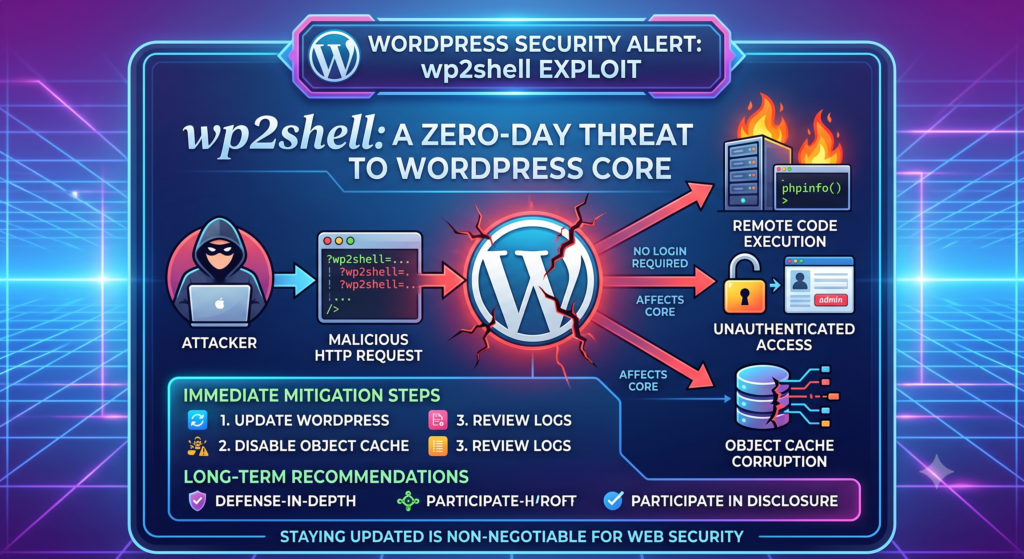
WordPress powers more than 40% of all websites on the internet, which makes it a favorite target for attackers. When a new vulnerability surfaces in the core of such a ubiquitous platform, the ripple effect can be massive. Recently, the security community uncovered a serious flaw dubbed wp2shell that allows anyone on the internet to execute arbitrary code on an unpatched WordPress site—no login, no plugins, just a simple HTTP request.
What Exactly Is the wp2shell Flaw?
The wp2shell vulnerability lives inside WordPress core, meaning it is present in a fresh installation without any themes or plugins. In short, an attacker can send a crafted HTTP request to a vulnerable site and trigger PHP code execution on the server. The bug affects the 6.9 and 7.0 branches, which were the most widely deployed versions at the time of discovery. As of July 18, 2026, the issue has been assigned CVE‑2026‑XXXX and CVE‑2026‑YYYY, and a fully functional proof‑of‑concept (PoC) is publicly available.
How Does the Exploit Work?
At a high level, the attack exploits a combination of two weaknesses:
- Unauthenticated request handling: WordPress processes certain query parameters before any authentication checks, opening a door for malicious input.
- Persistent‑object‑cache condition: When the object cache is enabled, a specially crafted request can corrupt the cache metadata, causing the server to load attacker‑controlled data as PHP code.
When these two pieces line up, the attacker can inject a string that WordPress treats as PHP, which then gets executed in the context of the web server. The PoC demonstrates this by dropping a simple phpinfo() call, but the same technique can be extended to upload web shells, modify files, or even create new admin users.
Why Is This So Dangerous?
There are three main reasons why wp2shell is a game‑changer for threat actors:
- Zero‑day, zero‑privilege: No authentication, no plugins, no prior foothold required.
- Wide impact surface: Every site running WordPress 6.9 or 7.0, even fresh installs, is vulnerable until patched.
- Stealth potential: Because the exploit runs through normal HTTP traffic, it can bypass many basic WAF rules that only look for suspicious URLs or file uploads.
In practice, an attacker could deface a site, steal database credentials, inject malicious JavaScript for SEO poisoning, or use the compromised server as a launchpad for further attacks against the hosting environment.
Step‑by‑Step Walkthrough of a Typical Attack
Below is a simplified flow that mirrors the public PoC:
- The attacker identifies a target running WordPress 6.9 or 7.0.
- Using a tool like
curlor a custom script, they send an HTTP GET request containing a specially encodedwp2shellpayload in a query parameter (e.g.,?wp2shell=base64_encoded_php). - WordPress processes the request, inadvertently writes the payload into the object cache.
- The cache is later read as part of a normal page load, causing the PHP interpreter to execute the attacker’s code.
- At this point, the attacker can run any command they like—creating a backdoor, modifying files, or exfiltrating data.
Because the entire chain relies on legitimate WordPress functionality, many security tools see it as benign traffic, making detection especially tricky.
Immediate Mitigation Steps for Site Owners
If you manage a WordPress site, here are the actions you should take right now:
- Update WordPress core: Versions 6.9.1 and 7.0.2 contain the official fix. Apply the update via the dashboard or CLI.
- Temporarily disable object caching: If you rely on a persistent cache (Redis, Memcached, etc.), turn it off until the patch is applied.
- Review server logs: Look for unusual
GETrequests containing the stringwp2shellor large base64 payloads. - Implement a Web Application Firewall (WAF): Add a rule to block requests that contain suspicious query parameters matching the PoC pattern.
- Rotate credentials: After patching, change database passwords and any API keys that may have been exposed.
These steps will dramatically reduce the window of opportunity for attackers while you assess any potential compromise.
Long‑Term Recommendations for Developers
Beyond the emergency response, developers should adopt a more defensive mindset to prevent similar issues from slipping into future releases:
- Sanitize early: Validate and sanitize all user‑supplied input before it reaches core processing functions.
- Avoid loading untrusted data into the object cache: Cache only data that has been explicitly marked safe.
- Adopt a “defense‑in‑depth” approach: Combine security headers, rate limiting, and runtime application self‑protection (RASP) to catch abnormal behavior.
- Participate in responsible disclosure: Encourage security researchers to report findings through official channels, and reward them appropriately.
By embedding these practices into the development lifecycle, the WordPress community can raise the bar for future attacks.
What the WordPress Community Is Doing
The core team acted quickly once the vulnerability was reported. After the CVE IDs were assigned, a security patch was released within days, and the issue was added to the official security release notes. The team also published a detailed advisory explaining the root cause and recommended mitigations. Community volunteers have started drafting additional hardening guides, and many popular managed WordPress hosts have already pushed automatic updates to protect their customers.
Why Staying Updated Is Non‑Negotiable
WordPress’s popularity is both a blessing and a curse. While it offers a vibrant ecosystem of plugins and themes, it also makes the platform an attractive target. History has shown that even well‑maintained sites can be compromised if they lag behind on updates. The wp2shell episode reinforces a timeless lesson: treat core updates as critical as any security patch for a server operating system.
Final Thoughts
Discovering a remote code execution flaw that works on a fresh WordPress install is unsettling, but it also highlights the strength of the open‑source model. The rapid disclosure, swift patch, and collaborative mitigation efforts demonstrate how the community can rally around a crisis. As a cybersecurity enthusiast, I’m reminded that vigilance, prompt patching, and a healthy dose of curiosity are our best defenses against the ever‑evolving threat landscape.
Original article: Read More Here
About the Author